


A Country That Prices Girls Out of Existence Cannot Call Itself Modern - Dowry Market in India
I come from a fairly privileged Indian family and all my life I’ve seen how the women in my family transfer down wealth, it’s gold. That’s my parents’ ‘G’ (pun intended). When my mom got married, her parents sent her to her husband’s home with a certain amount of gold. That’s her safety vault, that’s the safety vault of every woman in our country who isn’t financially independent. Nevertheless, this time when I came back home for my trimester break, I was talking to my sister and she told me how my parents have started to hint towards her marriage and she is not impressed. But she gave it a chance, they spoke about it and that’s when they discussed how much it would cost. And dear lord, I think court marriages should become the norm in our country. Indian weddings bleed money. But that is one thing; what truly got me was how my mother proudly asserted that she wanted to give my sister a precise amount of gold and silver when she was wedded. That is dowry in the vocabulary of everyday life, though everyone prefers to call it ‘gifts’ now. The intention is cushioned in love and security, but doubts, questions still remain - If the purpose is wealth transfer to safeguard a daughter’s future, why must it be tied to marriage? Why not put it in a will, or better, in her own bank account under her own name? How are we allowing this primitive practice to dress up as modern love?
I went down a rabbit hole, spoke about this with people around me and researched a bit. My conclusion is simple - this happens everywhere, including people from your immediate social circles to the otherwise general population in India, irrespective of the socio-economic background. To say that the numbers and papers I looked at are shocking, would be an understatement.

Dowry persists in India not as tradition but as an entrenched market, run by social pressure, distorted incentives, and the simple workings of supply and demand. This is not an emotional exaggeration. It is supported by alarming data and decades of academic work. According to Lindy Miller (2023), 90 percent of Indians continue to practice dowry, which makes India globally unique because most nations abandon dowry as they modernize. The consequences are not subtle. In 2022 alone, 6,753 women died due to dowry harassment, almost twenty every single day, including murders and suicides linked to abuse from husbands’ families. This number is reported by the National Crime Records Bureau (NCBR), which means that the true figure is likely much higher due to severe underreporting.
India has had the Dowry Prohibition Act since 1961 and Protection of Women from Domestic Violence Act since 2005. Yet dowry crimes have not declined. Tamanna Swain (2023) highlights that more than 1,700 women died by suicide in 2020 due to dowry related abuse. And that’s not even the most disturbing part, it is the judicial outcome that makes you numb. A study reported acquittal rates as high as 96.7 percent in dowry murder cases, such as in State of Karnataka v. Pundalik (1999). They claim that perpetrators operate with confidence because the law rarely bites. UNICEF reported in 2012 that 57 percent of Indian boys and 53 percent of girls aged 15 to 19 believe wife beating is justified. The next generation sees no reason to rebel because they are trained to accept violence as tradition.
One theory economists use to explain this persistence is Sanskritization. Prof. M. N. Srinivas coined the term to describe how lower castes adopt upper caste practices to climb the social ladder. Hoping to emulate status, lower castes copied it. However, Lindy Miller notes that if this were the only driver, we would observe rising dowry primarily among lower castes. Instead, dowry has risen uniformly across castes.
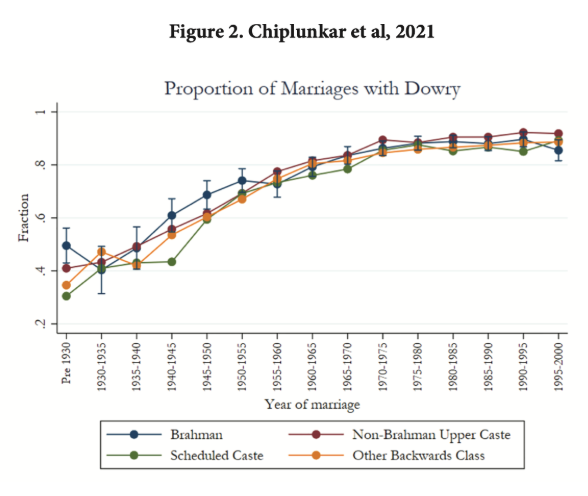
The second explanation is the marriage squeeze theory. Since men marry later than women, fewer eligible grooms exist relative to brides at any given time. In 1990, the overall sex ratio was 94 women for every 100 men (Chiplunkar, 2021), which might suggest women are scarce. Yet the marriageable age sex ratio flipped the picture. There were 107 marriageable women for every 100 men. Applying basic demand and supply, we know that - families bid for husbands with money, gold, and assets. A higher husband premium means higher dowry. This theory explains the problem partly but does not justify why families continue even after achieving economic stability.
The most convincing theory is the groom price model. Dowry in 21st-century India is a market transaction that prices men based on their perceived future income streams. Higher education, stable jobs, and caste acceptability all increase the groom’s market value. As India’s education expanded and white collar jobs increased, bride families were willing to pay more for “premium quality grooms.”
The Youth in India - Situation and Needs survey (2006 - 07) shows us some heterogeneity analysis, conclusions being - wealthier households are more likely to engage in dowry payments, more years of schooling implies more compliance, and rural families are significantly more likely to participate than urban ones. Love marriages, where families have less bargaining control, are negatively associated with dowry. Religion barely changes anything for men, though Muslim women are reported to be 42 percent more likely to pay or accept dowry compared to Hindu women, and those from other religions 26 percent less likely.
Dowry is not only an economic burden, it also shapes who gets to live. Gold is one of the clearest markers. 90 percent of dowry includes gold (Chiplunkar, 2021). As gold prices rise, dowry costs rise with it almost proportionately (Teays 1991). Girls become more expensive when gold becomes more expensive. The result is another disturbing real world outcome.
According to the NCBR reports, a 1 percent global increase in gold prices in 1985 correlated with an estimated 33,000 additional “missing” female births in the following years. Professor Sonia Bhalotra at the University of Essex proves causality. Her paper, ‘The Price of Gold: Dowry and Death in India’ (2016) merges monthly gold price data from 1972 - 2005 with birth cohort data of more than 100,000 infants. When gold prices rose by 6.3 percent, neonatal mortality rates for girls rose by 6.4 percent, while boys experienced no impact. Those girls who survived the inflation months were later found to be shorter as adults, likely due to nutritional neglect such as reduced breastfeeding. The message could not be more mind numbing - wealth extraction through dowry kills girls, and those who survive often bear lifelong scars. India’s Census Office confirmed that only 900 girls were born for every 1,000 boys between 2013 and 2015, despite high economic growth. That is two Indias like Vir Das says right here - one quietly erases its daughters while the other celebrates being the 4th largest economy in the world.
Dowry was never meant to be this. Historically, it was called ‘streedhan’, a woman’s personal wealth legally meant for her own security (Rao 1982) before the Hindu Succession Act that allowed female children a right to inherit their parents assets, abolishing the ‘limited owner’ status. Yet, another noble concept parasitized by patriarchy. Today, dowry often becomes the justification for violence. Swain (2023) notes that women torture women more often in dowry abuse cases because mothers in law police the same system that once controlled their lives. Even families who refuse dowry for well qualified sons are treated as suspicious and socially inferior. Violence persists partly because society rewards compliance and punishes deviation.
This is the blunt truth - a daughter is viewed as a liability while a son is viewed as an asset. Each dowry transaction reinforces this logic. Families who pay for daughters become convinced girls are a financial loss. Families who receive dowry for sons become convinced boys are a financial gain. The next generation sees these outcomes and doubles down on the same. Dowry feeds misogyny and misogyny feeds dowry. A perfect equilibrium for literally everyone except women.
We just finished celebrating Dhanteras last week, worshipping Goddess Lakshmi and God Kubera - welcoming gold and silver into the household. Meanwhile the same glitter is the currency of a practice that as we have already established helps price girls out of existence in some households. Invite Laxmi and Kubera to the house, sure. Maybe also flip yourselves an article about the price per life of that gold, if not stop the practice of dowry in your household at least. A progressive society cannot treasure gold more than girls. Maybe try and give women financial independence before marriage instead of packaging their worth into gold biscuits that buy conditional acceptance.
Happy. Diwali. For a ‘modern’ country that praises women as goddesses multiple times a year, we still price actual girls out of survival for the sake of a trousseau. That contradiction isn’t tradition; it’s an economy with a moral failure.


