


Tea( they) not Like Us
Updated: Oct 11, 2025
Sri City: I come from
a people who pray five times a day
and make tea. I admire the way they do
both. How they drop to the ground wherever they are. Drop
pine nuts and mint sprigs in a glass.
I think to care for the self
is a kind of prayer. -Leila Chaitta, Tea
In a teapot of boiling water, go whole spices and tea leaves that bleed a dark red. A stream of milk follows, disrupting the violent red and black of a boiling concoction with clouds of diffused white. What was once a pot of boiling water becomes the comfort of an entire country- chai
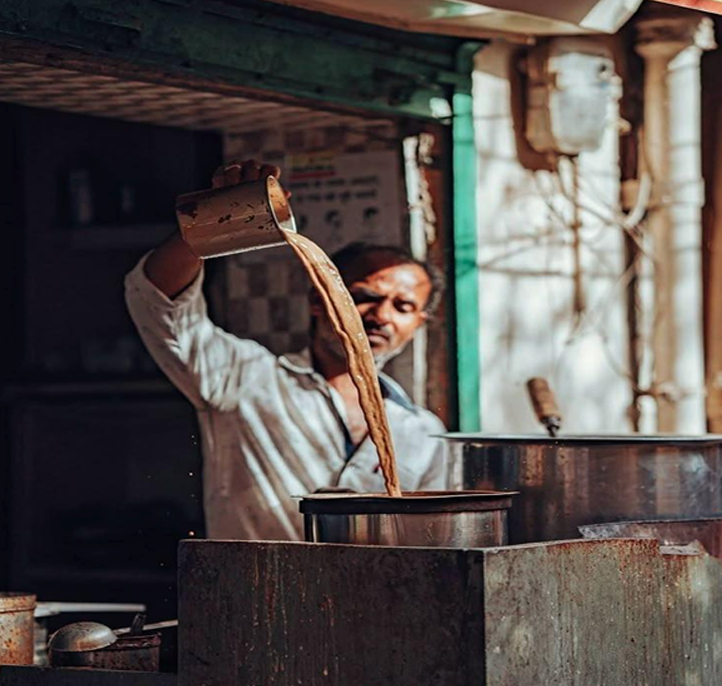
I, and my watchman bhaiyya, usually end up at the same chai tapri- the one that sells kulhad wali elaichi chai by the seaside. The chaiwale bhaiya always gives me the nicer kulhad and a knowing smile. But other than those ‘regular customer’ privileges, we all get the same sugary, milky chai all of us- the watchman uncle I know, the didi who sells mogra on the street, and the college students with AirPods in their ears. I enjoy this-a shared moment of solitude. We all have different places to be, different reasons to visit the tapri, and different styles of holding the kulhad, but we all drink the same chai that rests in the earthy brown, brittle-to-the-skin kulhad- Perhaps, that’s what I love the most about chai- the 10 rupee comfort that fuels everyone in the city, no exceptions. What I love more is the chaiwale bhaiya who always remembers to wrap my kulhad in a tissue, because I winced at its warmth once. His finesse of the near choreographic, rhythmic-routine of making chai often leaves me amused. He breathes the life into it- movement from the ladle to the brimming pot, the steaming chai suspended in the air somewhere in between the two.
My people love tea so much
it was once considered a sickness. Their colonizers
tried, as with any joy, to snuff it out. They feared a love
so strong one might sell or kill their other
loves for leaves and sugar
-Leila Chaitta, Tea
Chai wasn’t always chai, it was tea- the luxurious beverage of the British elite; forced to be cultivated by Indians for the sheer greed of the colonisers. While the warmth of teacups started reaching the hands of Indian elites, the wrath of injustice was taking the lives of Indian plantation workers. The deceased bodies of labourers- away from home, stranded and perished from starvation, hunger, and exploitation, turned pale to blue to black while the British enjoyed their whole leaf black tea. As the British expanded the tea market to India itself through propaganda advertisements, Indians were sold the residues of the British favourite whole leaf tea. They were given inferior ctc or mamri tea- so popularized and adopted by us, that it is the ‘chai paati’(tea powder) we still use in our Indian households today. The tea ‘dust’, the most inferior part of tea, was marketed towards the rural Indian. Our everyday tea-drinking tendencies come from more than 40 years of British campaigning for tea to Indians. However, the taste of the bland, failed, surplus tea that the British relied on the Indians to consume and get rid of- naturally did not suit our palette. It was the chaiwallas of India that made ‘tea’, chai. They added to tea, the tokens of their culture and the knowledge of their forefathers and mothers; with cardamom, ginger, tulsi, pepper, they turned the very object of their oppression into the chai we drink today, an act that was discouraged by the British because, according to them, adding spices translated into using ‘less’ volumes of tea powder. Thus, chai became an act of rebellion. They took the manifestations of tyranny, set against them, and instead created an object of legacy, comfort, and culture that echoes generationally, in our kitchen at the strike of dusk.
Decades later, with Chaayos and Chai Tea Lattes, the discourse around chai looks different. Chai in media has gone beyond Zakir Hussain’s Wah Taj advertisements and reached Pinterest. Recently, I stumbled upon a post that said, “Chai is not just a beverage, it’s an aesthetic!" With 900 rupee chai scented lip glosses and 4000 rupees worth of Chai-scented perfumes, chai is not even about a beverage anymore. Chai-themed t-shirts, chai tote bags, chai scented cleansing bars, chai scented hand cream- there is a commodification and aestheticization of chai, transcending its position as a beverage.
What Broke Bond’s ‘Wah Taj’ ads with Zakir Hussain, chai-scented candles, and Pinterest posts of chai miss is- the chaiwale bhaiya who is the very backbone of this ‘trend’. While companies and individuals capitalise on this reliance and love for chai that exists in Indian society, the chaiwalas who made chai what it is today, remain invisible on the sidelines, struggling to make ends meet. The livelihood of one becomes the ‘aesthetic’ of another. The chaiwale bhaiya neither gets recognition nor monetary benefits.
Commodification and trends rely on relatability and accessibility. A good trend is one that is easy to adopt and easily liked- the groundwork of all of which is done by the humble chai tapri. However, the benefits of this trendi-fication do not benefit the chai tapris. The ordinary chai is available in every household, but its aesthetic by-products? Irrelevant and inaccessible to the masses
i.e., the major clientele of the chai tapri. The point I make is not to condemn these products emerging from the love for chai, but rather who are the people benefiting from this trendi-fication
of chai? There is a visible class divide to be observed through this. When companies and systems create products around the theme of chai, there's a notion of ‘cool’, desirability towards the product, but the same cannot be said about its subject- chai and the ones who sell it. Thus, chai no
longer remains an object of history, community, or an accessible comforting beverage, but rather this capitalisation and commercialisation of it places a particular concept of chai on a pedestal.- high enough to be out of reach but low enough to want to jump to grab it.
While ‘Dirty Chai martinis’ are all the talk, the chaiwalas who turned ‘tea’ into ‘chai’ are the ones labeled ‘dirty’. It is true that chai is not just a beverage, but neither is it a mere aesthetic. With the growing aestheticisation of chai, the a growing demand for ‘luxury’.The trend-ification strips chai away from all the very things I adored it for, its simplicity, context, and most dearly the ‘for all’ comfort and welcome it provides. Chai is not a mere product, beverage, or commodity. It is the vessel that carries the silent rage, resistance, resilience, and histories of generations before us. Chai is one such object that moulds itself to your liking, given the milk-to-chai ratio, elaichi or ‘aadrak’ decision, and ‘cheeni kum, nahi cheeni zyaada’ factor. The aestheticisation of chai takes away the complexities of this simple beverage. So I do not enjoy the aestheticisation of chai or its candles and notebooks and tote bags, because when I think of chai and my love for it, I still want to go back to the chai tapri that my watchman uncle and I are ‘regular customers’ in.


