


The Physics Φ-esta 2025

Sri City: If you passed by the JSW atrium last weekend, chances are that you might have dropped by, perhaps to see students and faculty with their experiments and demonstrations based on physics. Well, if you haven’t, let us walk you through this two-day carnival. It was Krea’s very own annual mini science carnival, “Physics Φ-esta ”. The usually not-so-silent atrium was busy not with any cultural events but with demonstrations, lively discussions, and students wide-eyed from every major. Organized by the Department of Physics, the event aims to introduce people who are not pursuing science or physics to spark their interest and give them a taste of the wonder and curiosity that drives them to pursue physics. With less than five percent of Krea’s students studying physics, the event is a way to share that curiosity more widely with the campus community. It is a collective effort put together by both students and faculty. The actual preparations behind what we see begin one month before the event, including planning and approval of experiments for the showcase, as well as sending out emails. According to Darshan, one of the student organizers, “A bunch of proposals are made by both students and the faculty members of the department, and then we select the best ones that are feasible. Well, of course, the faculty is the host. Both take the lead. The students volunteer along with them, and we make sure to do our best. Honestly, it’s an equal competition.”
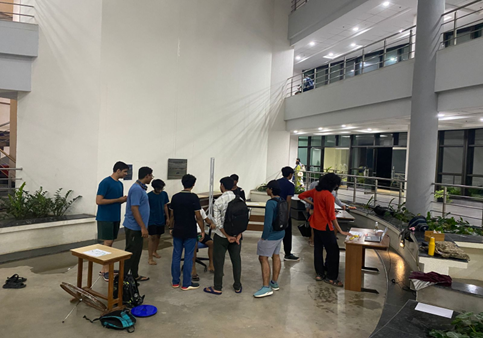
The atrium and the physics lab were both set up with a range of experiments that students and visitors could explore and learn from. Another volunteer said that some experiments took place in open spaces, like the triad, to attract passersby, who would often stop by, curiously ask questions, and show interest. Among the experiments, one of the most popular was the Banana Capacitor, where two bananas were used to control the Chrome Dino Game. The setup provided a straightforward way to explain concepts such as capacitance and electric charge. Visitors could observe gyroscopic motion in action, explore the physics of chaos, or discover how birefringence reveals hidden patterns of light. In one corner, a rotating chair illustrated angular momentum, while in another, the “Liquid Skin” setup demonstrated how surface tension allows certain materials to appear to walk on water. Each showcase was uniquely designed and named in a quirky way- like “Crazy Little Things Called Chaos”, “Set Fire to the Current”, and “Go Bananas Over Circuits”- which definitely made people stop, explore, and ask questions. Some students say how it was very surprising to realize how everyday objects could involve and explain complex concepts like the ones there.
Although this year’s Physics Φ-esta didn’t have a fixed theme, the team drew inspiration from a quote by physicist Richard Feynman: “The first principle is that you must not fool yourself and you are the easiest person to fool.”.
Apart from the demonstration and experiments, this two-day event has much more to offer for the Krea Community. There were numerous opportunities for the students, including seminars, competitions, stargazing, and movie screenings. All of these took place in our very own JSW Academic Building. The seminars by the Professors and some talks by fellow students provided a great opportunity for the students to explore the field further. Especially, the first-year students intending to major in physics or other related majors benefited greatly.
Professor Sushant Raut spoke about “A Song of Fire and Ice: A Neutrino’s Tale,” explaining how the elusive particle neutrino. Next, Ramadas N led a session titled “Can Quantum Solve the ‘Impossible’? Exploring Euler’s 36 Officers Problem,” linking historical mathematics with quantum theory.
Some talks blended philosophy and physics, such as Professor Manu Kartik’s “Schrödinger’s Cat and Pavlov’s Dog: A Red Herring or a Wolf in Sheep’s Clothing?” and the other by Professor Aritra Gupta’s “Back in Black: Shedding Light on Dark Matter.” These seminars were scheduled in a way that allowed students to drop by in between, and most sessions saw an engaged audience asking questions throughout and at the end, as well as connecting with each other. These seminars were designed with accessibility in mind, ensuring that even those unfamiliar with the topics could follow along.

As mentioned before, the phiesta had some fun events, which included a movie screening of "Good Night Oppy," a documentary about NASA’s Mars rover, Opportunity. The screening was later followed by discussions on space exploration for interested ones. Lastly, this spectacular program was set to end with the Stargazing Night on the JSW terrace, but had to be cancelled due to unsuitable cloudy weather. Although many students hoped it would return next year, as it is supposedly one of the most anticipated parts of the event.
And just like that, this two-day Physics Φ-esta ended on a note of curiosity and collaboration. We appreciated the collective effort of the Department of Physics in organizing such an event, as well as the students' curiosity and willingness to learn.

